Jikken — Governing Feature Flags Across Four Product Surfaces
Studio start-up. Jikken is a feature-flag governance system designed and built end to end by Experience Plus using an AI-assisted development workflow. It is organized around one demanding product principle: a rollout decision must keep the same meaning across the CLI, Dashboard, SDK, and CI gate.
Role: Independent Product Design & Engineering · Year: 2026 · Timeframe: Several days
- Product surfaces
- 4
- Shared engine
- 1
- Defined exit codes
- 0–6
- Spec to deployed product
- Days
Product Walkthrough
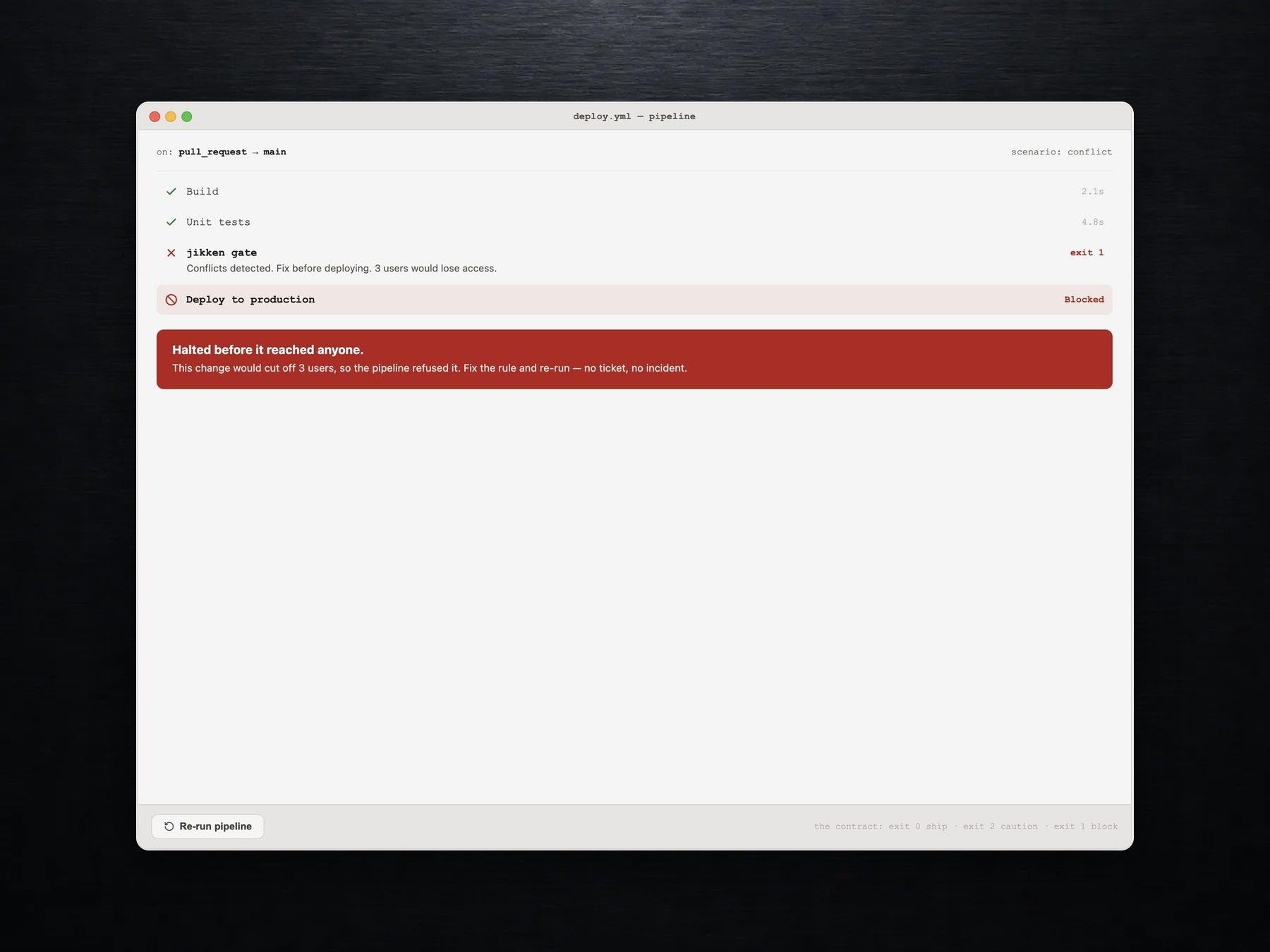
Follow one proposed targeting change through the complete system—from the first CLI conflict to the Dashboard review, SDK response, and CI gate that stops the unsafe deployment.
The Challenge
Feature flags start as simple switches. At scale, each switch becomes a policy interpreted by engineers, product managers, application code, and delivery pipelines. The risk is not only a bad configuration. It is semantic drift: a change can look safe in one interface, ambiguous in another, and still reach production because each surface tells a different story.
Jikken was conceived as a governance product for that gap. Before a rollout ships, it evaluates a proposed change against a representative audience, shows who gains or loses access, assigns an allow, hold, or needs-review verdict, and carries the decision—with its reason and audit trail—through every place it is consumed.
One Decision, Four Surfaces
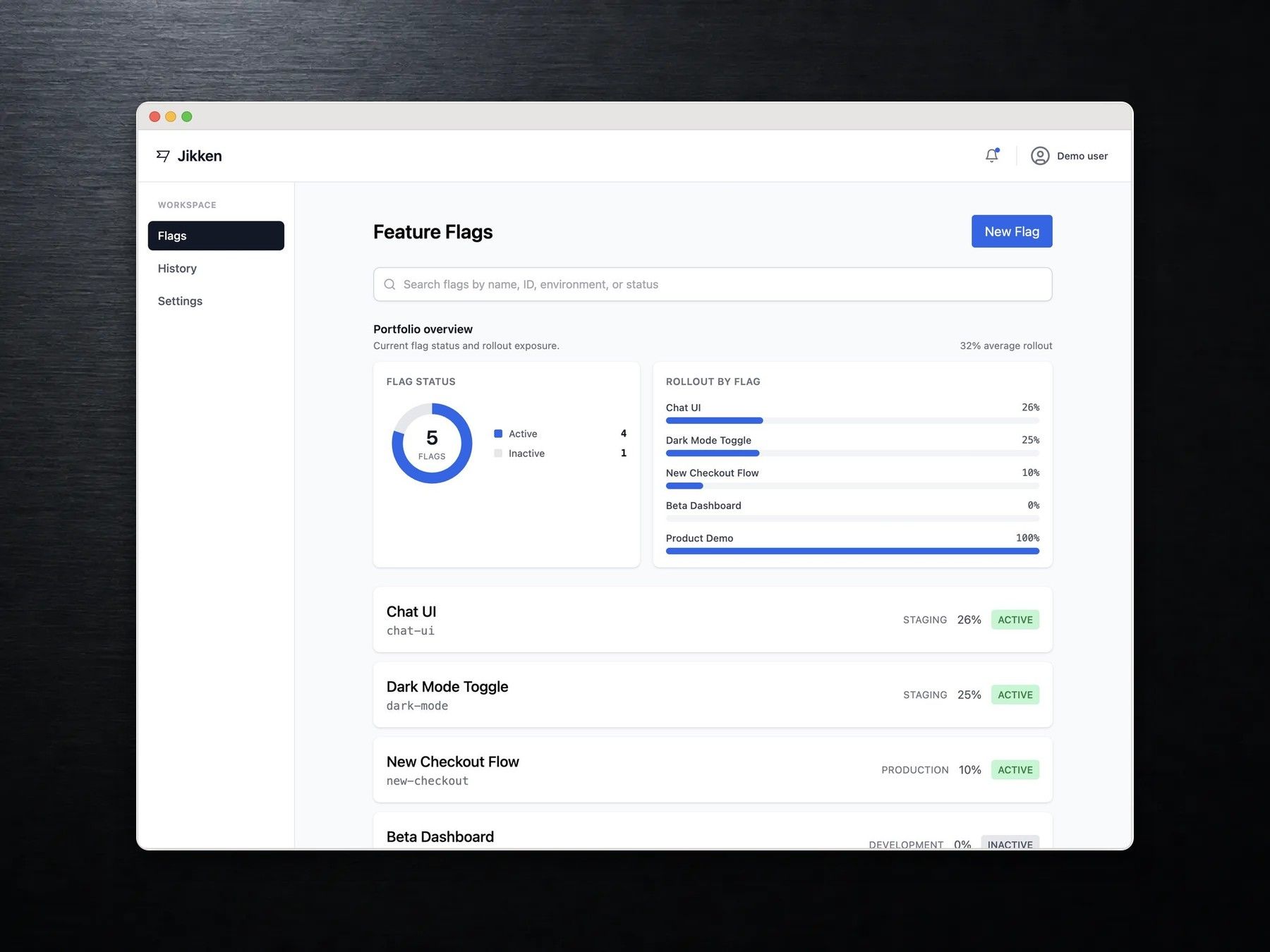
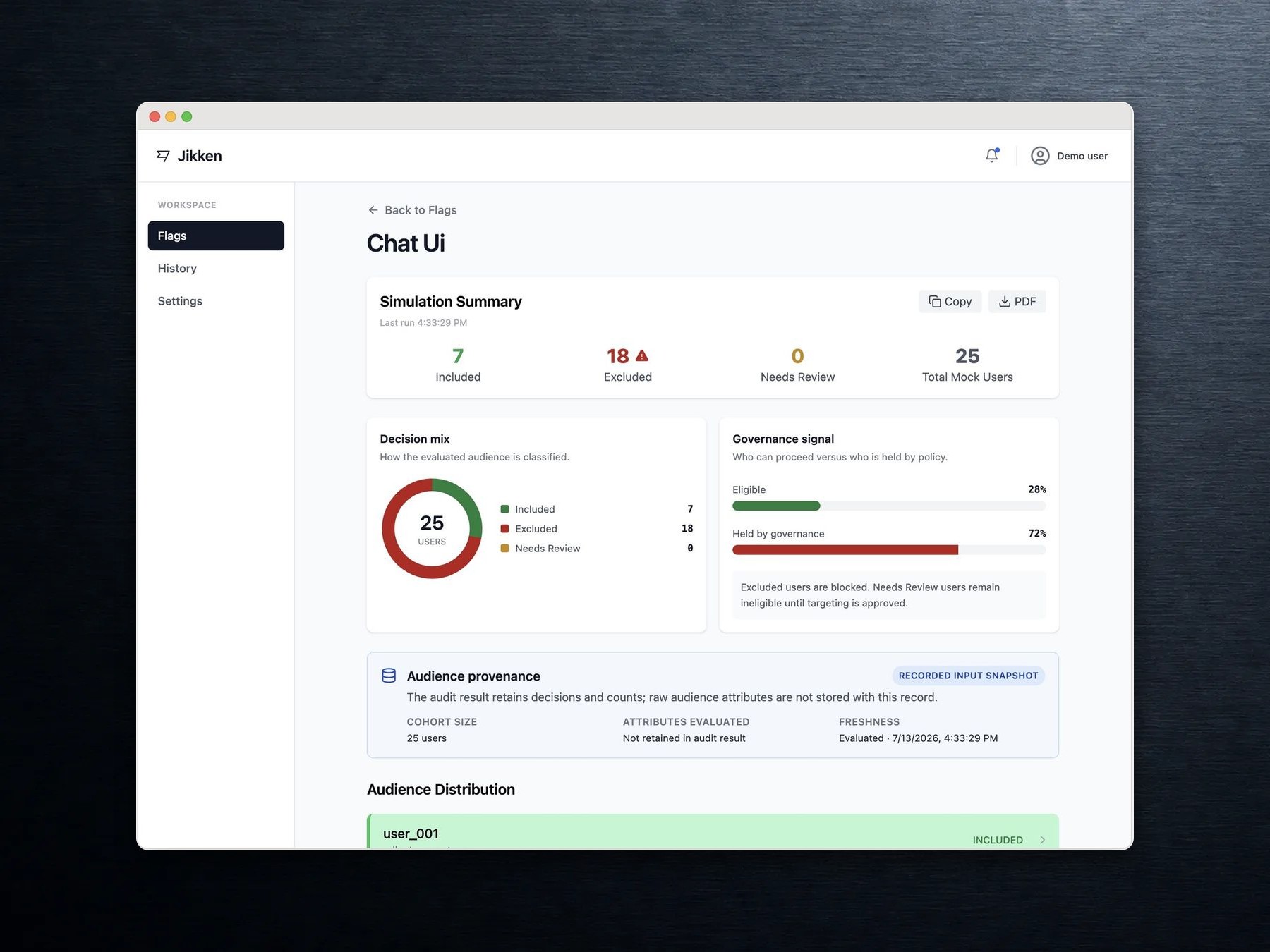
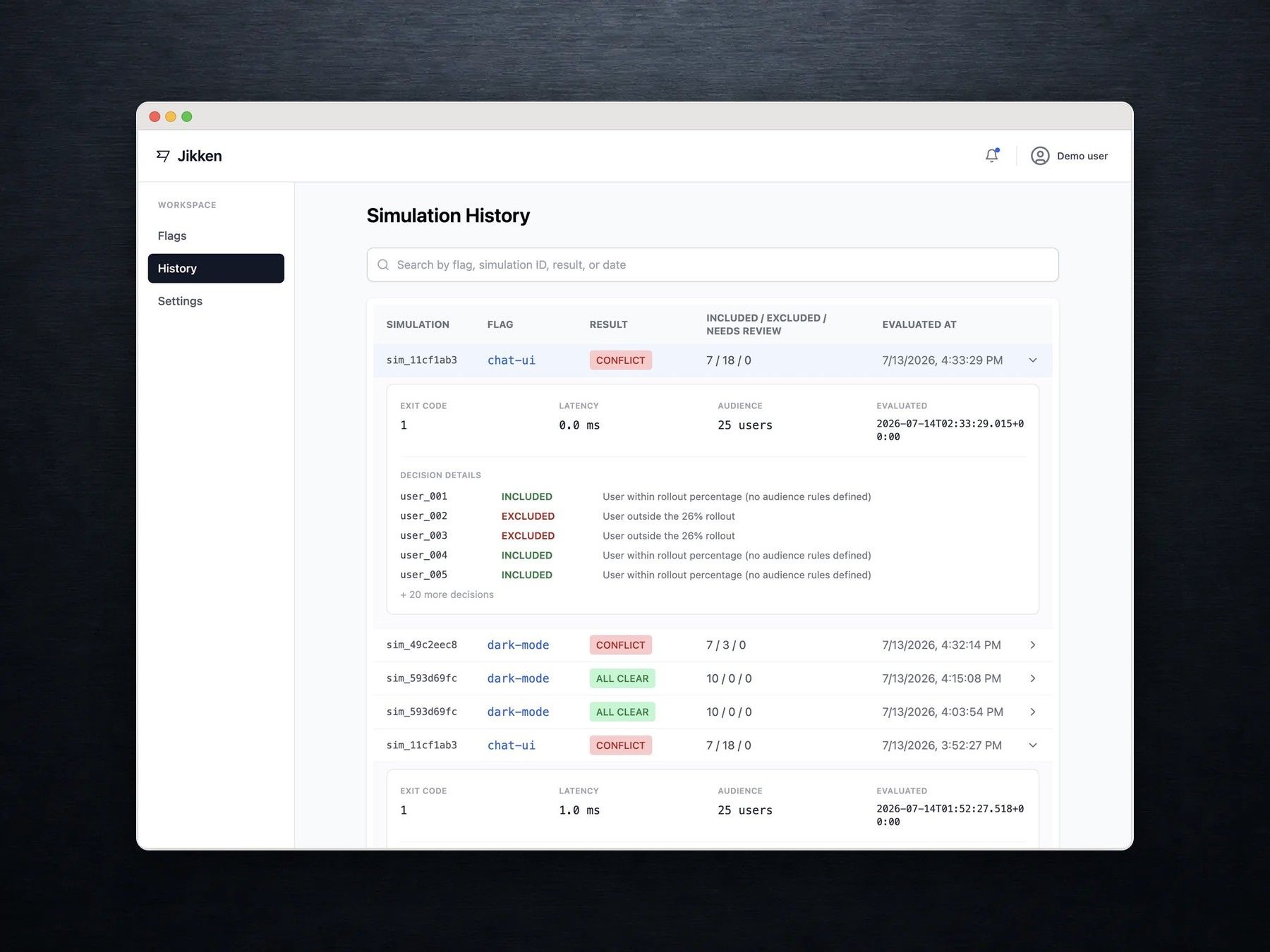
The experience was designed as one continuous product flow rather than four adjacent tools. The CLI gives engineers a terse diff and meaningful exit code. The Dashboard gives reviewers the audience context behind it. The SDK exposes the same typed contract to application code. The CI gate enforces the verdict before deployment.
Designing for Coherence
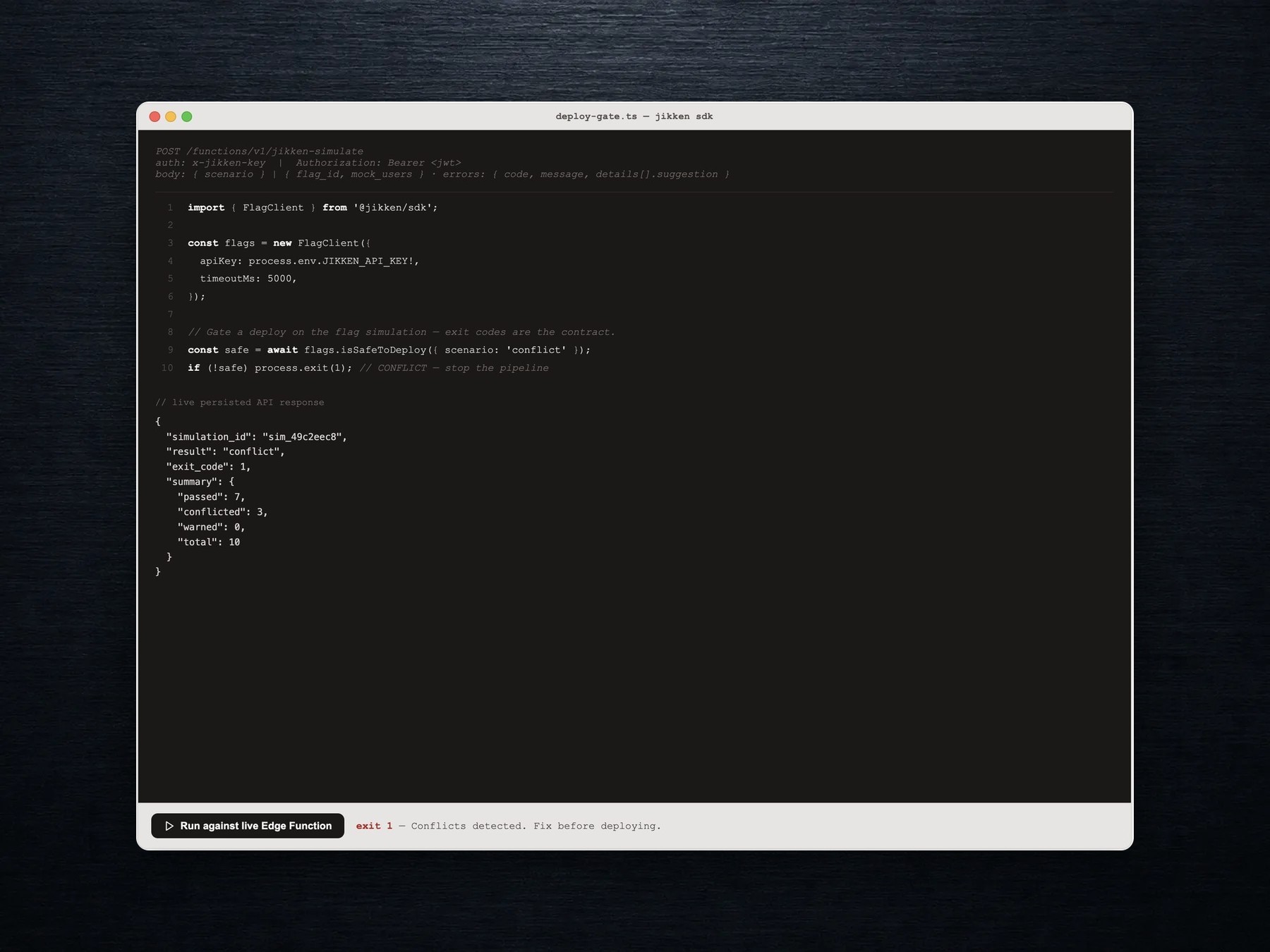
Consistency is the core feature. Green always means receives, red always means excluded, and yellow always means review. The field rollout_percentage is spelled the same way everywhere. Exit code 1 always means conflict. A simulation ID links the human-readable interface to the machine response, so reviewers and automation can refer to the same event without translating between systems.
- A deterministic, seeded TypeScript engine shared across browser, Node, and Supabase Edge runtimes
- Transparent decisions with reasons, source rules, audience provenance, and tamper-evident history
- Role-specific interfaces that preserve one underlying vocabulary and decision model
- Actionable validation that names the failing field and suggests how to recover
- A coherence test suite that fails the build when colors, terms, exit codes, or engine copies drift
The Machine Contract Is Part of the UX
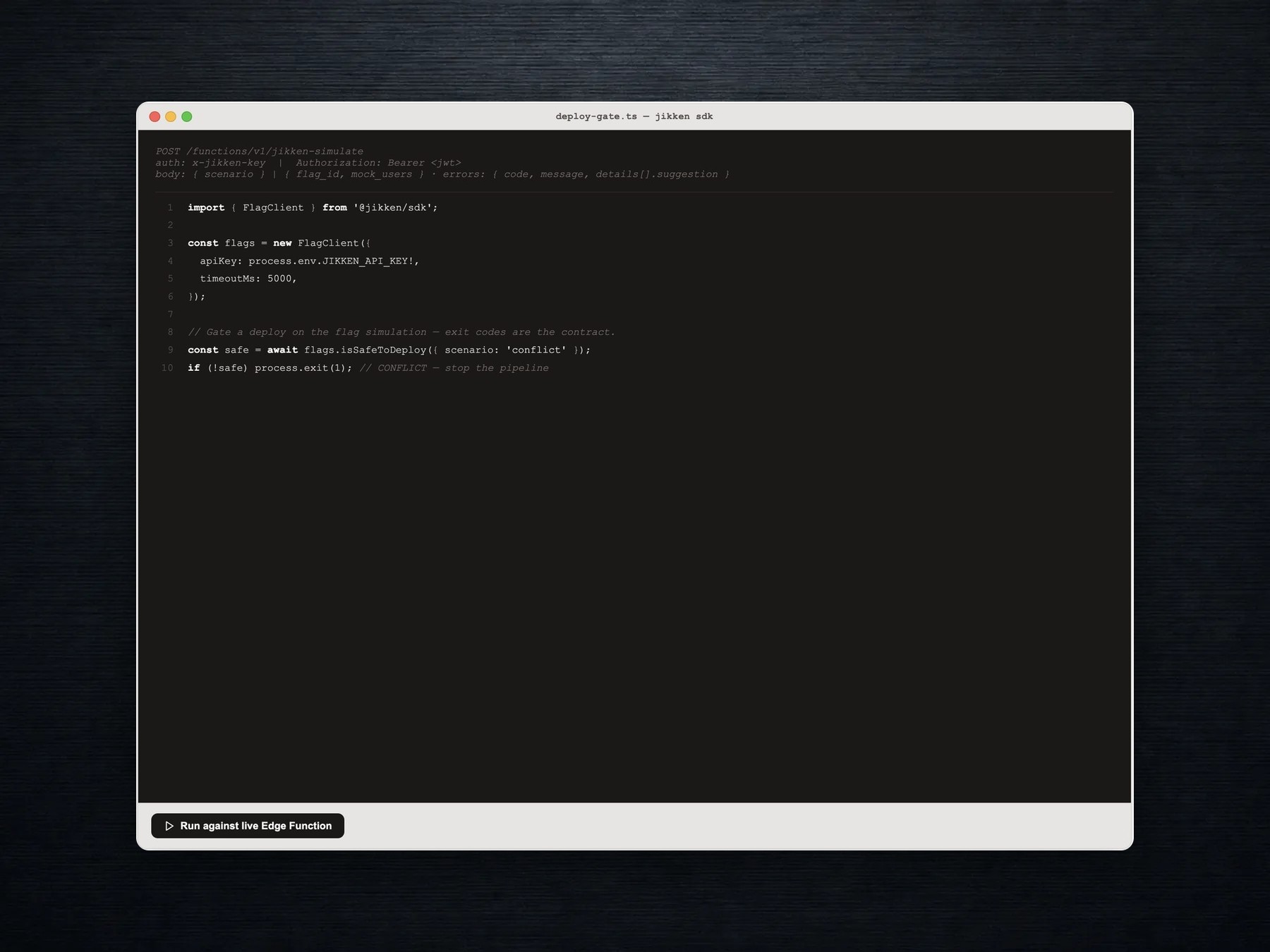
The SDK does not reduce a governance decision to an opaque boolean. It returns a typed result with the simulation ID, verdict, exit code, audience summary, and recovery guidance. Callers that only need a gate can use isSafeToDeploy(), while more sophisticated integrations can inspect the complete contract. The interface meets each consumer at the level of detail it needs without changing the meaning of the decision.
Technical Architecture
Jikken is a TypeScript monorepo with six workspaces: a dependency-free shared decision engine, Commander.js CLI, React Dashboard, typed SDK, guided product presentation, and portfolio site. The same engine runs in three environments—the browser, Node, and a Deno-based Supabase Edge Function—so the product does not reimplement its most important decision at each boundary.
A deterministic core
The shared engine is pure and seeded. It reads no clock, randomness, or environment variable that can affect a verdict. A stable FNV-1a hash assigns rollout buckets and derives each simulation ID from the flag, targeting rules, rollout percentage, and user IDs. Identical inputs therefore produce bit-identical audience decisions, summaries, and exit codes across every runtime.
Browser, machine, and pipeline boundaries
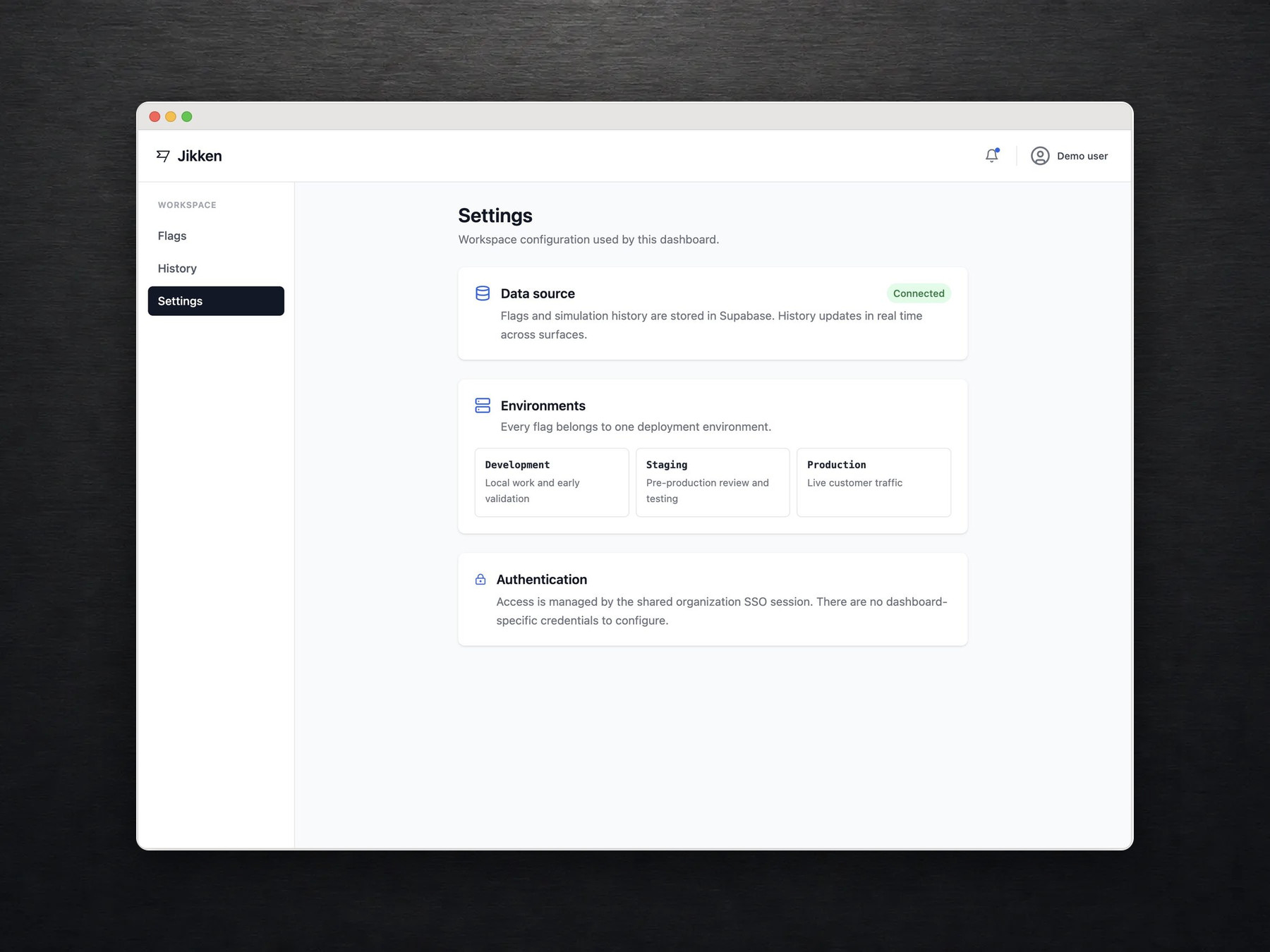
The Dashboard and browser presentation use the shared engine for immediate feedback. The Edge Function exposes the same evaluation to the SDK and CI, authenticating machine calls with a constant-time API-key comparison and browser calls with a Supabase user token. Requests are validated and bounded to 500 users before evaluation; successful runs are appended to the simulation audit log and streamed back to the Dashboard.
- React, Vite, and Tailwind CSS for the Dashboard and guided presentation
- Commander.js for simulate, validate, and diff commands with real process exit codes
- A typed TypeScript SDK with timeouts, structured errors, retry guidance, and isSafeToDeploy()
- Supabase Auth, Postgres audit storage, Realtime updates, and a Deno Edge Function
- Vitest integration contracts plus ESLint, type checking, unit tests, and GitHub Actions gates
The product thesis enforced in code
The integration suite turns coherence into a release requirement. It verifies that semantic colors resolve to the same Tailwind values, CLI process output exactly matches the in-process engine, Edge Function copies cannot drift from the canonical source, and rollout_percentage keeps one spelling across the CLI, Dashboard, SDK, and shared types. GitHub Actions runs linting, unit tests, these cross-surface contracts, and Jikken's own validation gate on every push and pull request.
Independently Built with an AI Development Workflow
Experience Plus conceived, specified, designed, engineered, tested, and deployed Jikken end to end. There was no separate product, design, or engineering team. AI tools—including Claude Code, Codex, and Gemma—were used as implementation collaborators inside a directed workflow: write the product specification, define the architecture and acceptance criteria, delegate bounded implementation tasks, inspect the running result, reject or revise incoherent output, and verify the accepted work through code review, type checks, tests, builds, and direct walkthroughs.
The workflow compressed the path from specification to deployed product to several working days, but speed was not the definition of completion. Human judgment determined the product thesis, system boundaries, interaction model, security posture, and release bar. Models accelerated production; the studio remained accountable for every decision and for the integrated system that shipped.
What Shipped
Jikken shipped as a working monorepo with a CLI, React Dashboard, TypeScript SDK, Supabase Edge Function, GitHub Actions gate, guided product presentation, and integration tests that enforce cross-surface coherence. The live walkthrough lets a reviewer follow one targeting conflict from the terminal to the production gate.